Bingyi Xia
SUSTech, Shenzhen

I am a final-year Ph.D. student in the Department of Electrical and Electronic Engineering at Southern University of Science and Technology (SUSTech). I am working at the intersection of robotics & AI, supervised by Prof. Max Q.-H. Meng and Prof. Jiankun Wang. Before that, I received my B.Eng. degree from the same department at SUSTech in 2020, where I worked on flexible electronic sensors with Prof. Terry Tao Ye.
My recent research focuses on autonomous navigation and human-robot interaction, particularly developing robot mobility and navigation capabilities for dynamic environments beyond the laboratory and human-centered field applications.
News
- 2026/08 One paper is available on arXiv, titled “Exposing the Long-tail in Embodied Urban Navigation via Scalable Learning from In-the-Wild Videos”.
- 2026/06 One paper is available on arXiv, titled “NavIsaacLab: Generating Realistic Crowd via Parallel Robot Learning for Benchmarking Human-aware Navigation”.
- 2026/05 One paper was published in IEEE Robotics and Automation Letters, titled “Learning Robot Visual Navigation in Crowds via Intention-Aware Scene Representations”.
Research
Embodied Urban Navigation
Learning embodied urban navigation from web-scale videos focuses on scalable point-goal navigation in city environments, with an emphasis on long-tail scenarios and real-world transfer.
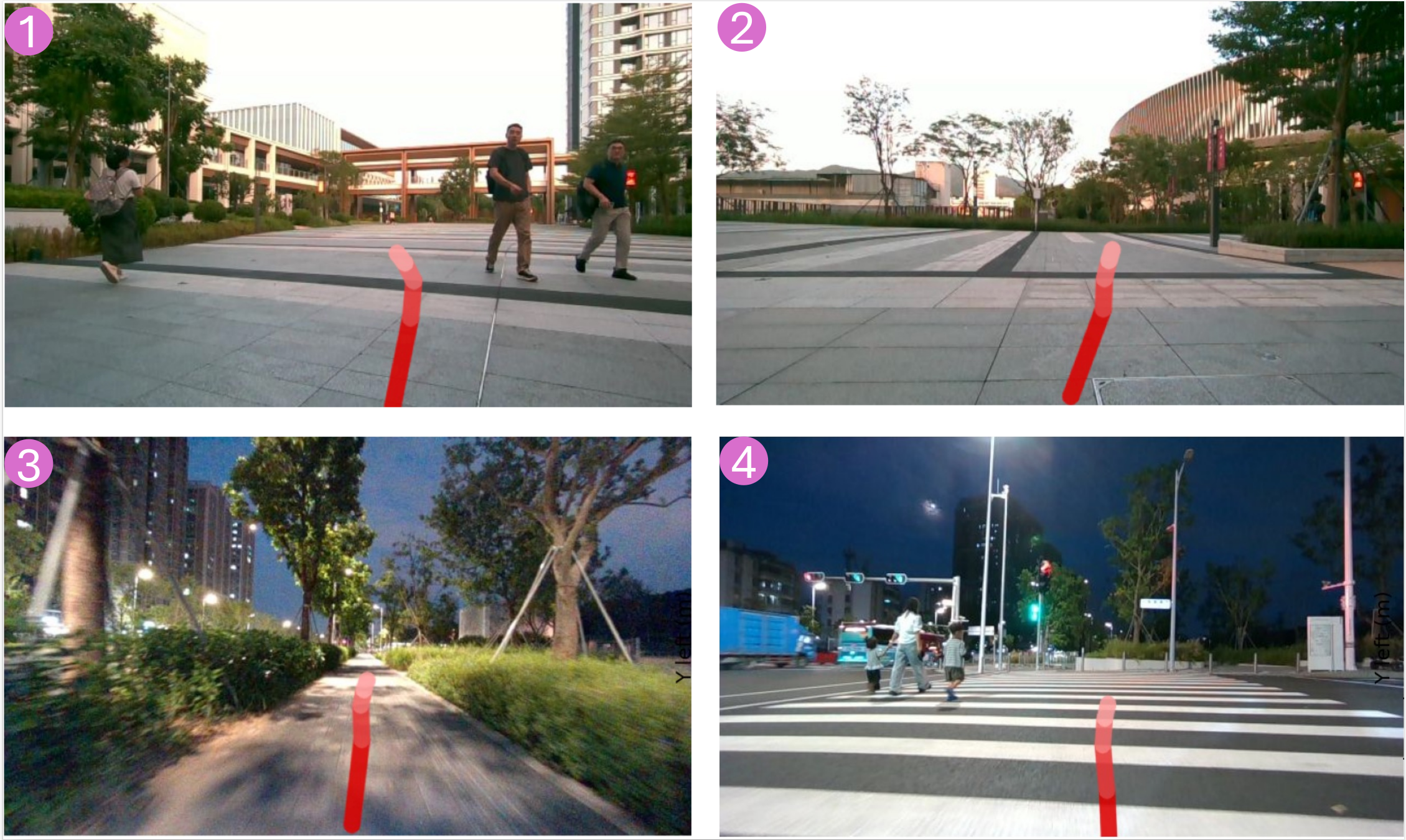
Learning embodied urban navigation from web-scale videos
It learns point-goal urban navigation from web-scale videos. The framework uses trajectory annotation and navigation semantics to train interpretable policies. It also analyzes long-tail scenarios and improves real-world transfer.
Social Navigation
Social navigation aims to enable robots to move safely, efficiently, and naturally in environments shared with humans. My research mainly addresses point-to-point navigation in crowded and dynamic environments through learning-based methods, covering data collection, global path planning, and RL-based navigation policies. Beyond general navigation tasks, I also explore person following as a special form of social navigation.
Human-Aware Navigation Simulation and Benchmark
NavIsaacLab builds photo-realistic, physics-based crowd simulation on Isaac Lab, using data-driven pedestrian generation for providing richer visual feedback and GPU-parallel environments to accelerate data collection and training human-aware navigation policies.
Intention-Aware Crowd Navigation
iCrowdNav learns RL-based crowd navigation policies from RGB-D observations by combining occupancy features with human pose cues, enabling the robot to infer pedestrian intentions and navigate more safely in dense crowds.
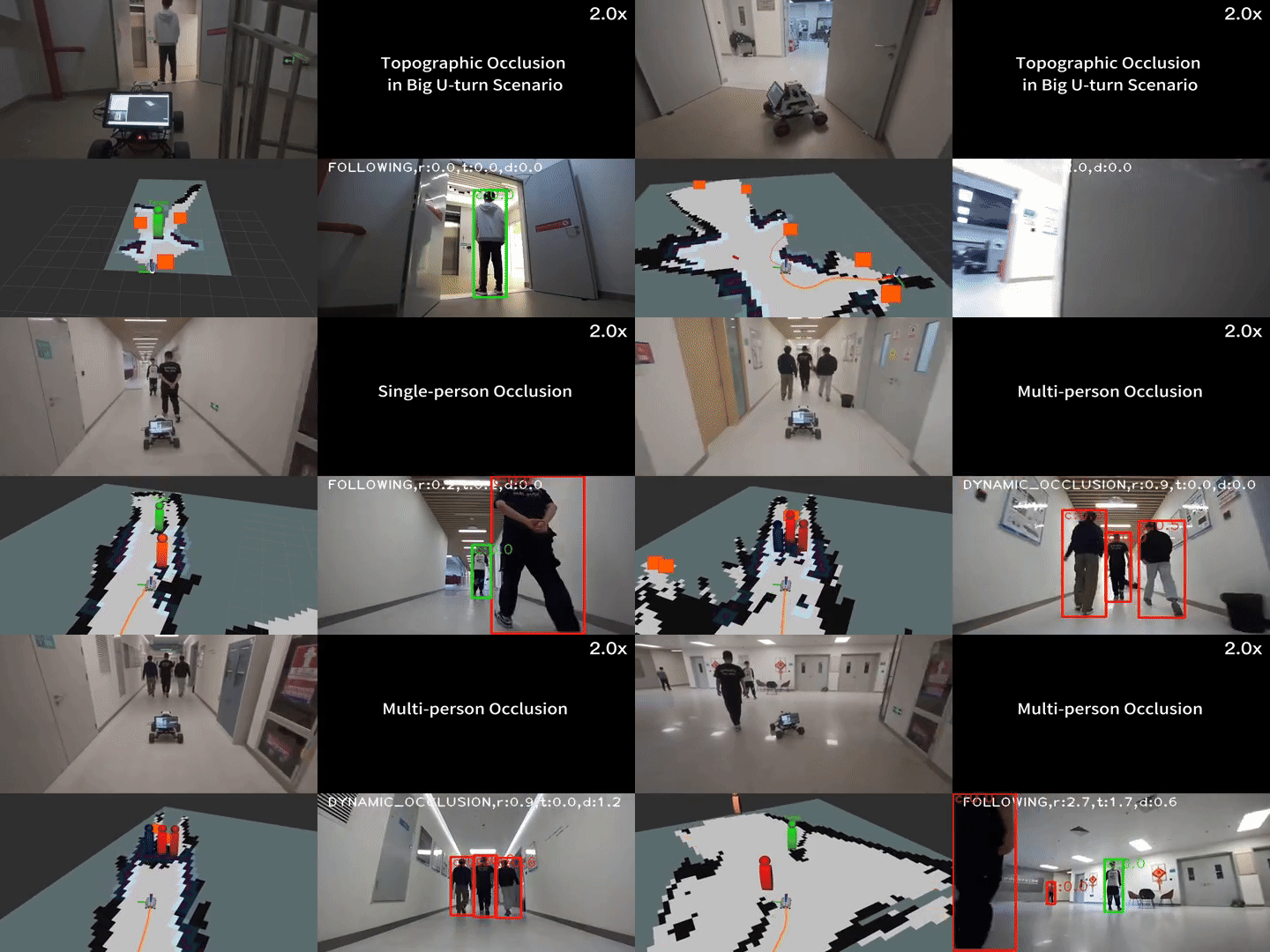
Person-Following
RPF-Search addresses target loss in unknown and dynamic environments, using belief-guided fields for topographic occlusions and adaptive search strategies for moving pedestrian occluders.
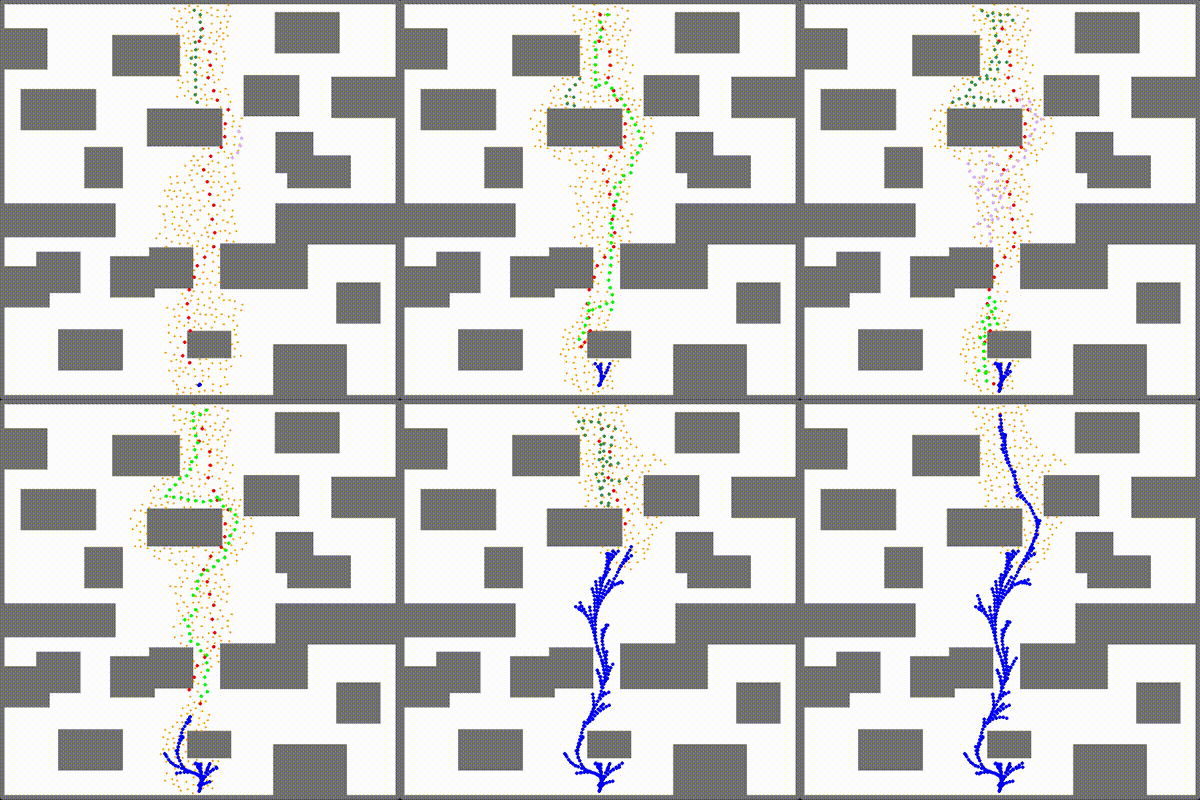
Neural Adaptive Path Planning
NAMR-RRT improves sampling-based planning methods by using neural heuristic regions to focus sampling on promising areas, reducing unnecessary node exploration for real-time computation in dynamic environments.
Mobile Manipulation: Cart Pushing, Collection, and Transportation
My research in mobile manipulation focuses on wheeled objects, such as carts, trolleys, and wheelchairs. We develop practical robotic applications built around cart pushing to automate manual trolley collection. We built a full-stack robotic system that integrates localization, perception, manipulation, formation control, and cooperative transportation, enabling two mobile robots to collect scattered carts, arrange them into a queue, and transport them to a target location. The robotic platform was iterated through three versions, evolving from a simple gripper-based mechanism to a dual-arm manipulation system.
Collaborative Trolley Transportation
This work develops an autonomous multi-robot system for transporting long lines of luggage trolleys, with a hierarchical framework for feasible path generation, online motion planning, and feedback control under coupled nonholonomic constraints.
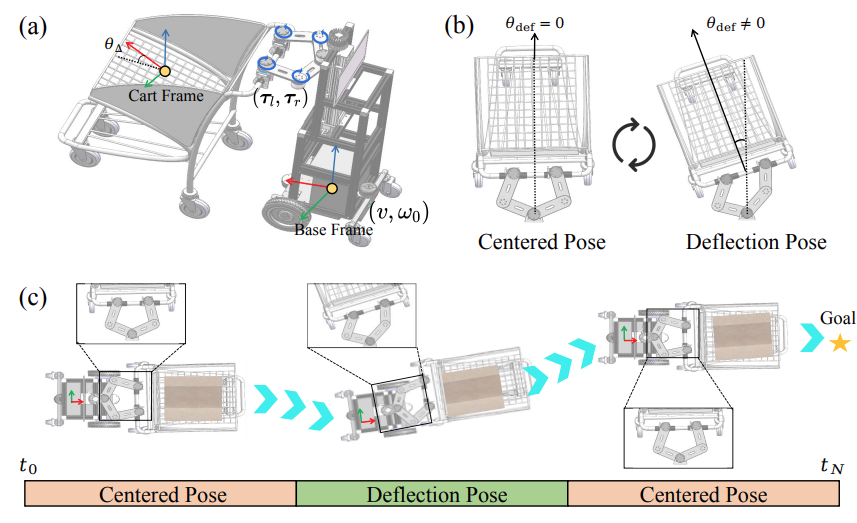
Robot Cart-Pushing
This work combines maneuverable push-pose planning with disturbance-rejection control, allowing mobile robots to push carts flexibly and robustly despite payload variation, redundancy, and external disturbances.
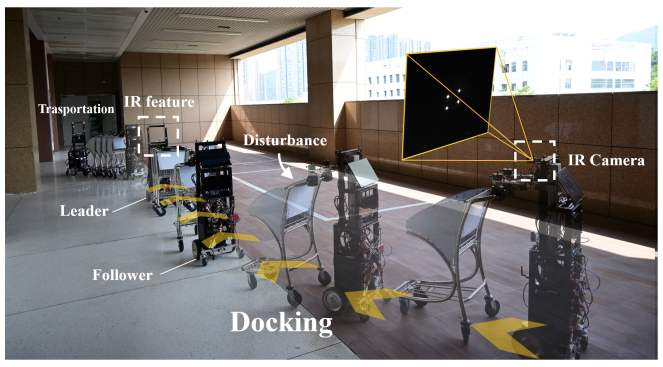
Autonomous Trolley Collection
This research builds a complete multiple-trolley collection system, including lightweight docking hardware, vision-based control, and disturbance-aware visual predictive control for accurate and stable trolley alignment in real service scenarios.